

Inicio / Doctorandos / Publicaciones
Publicaciones
22/05/2026
Personal comfort systems for adults with intellectual disabilities
Autores: Kaherine Exss, Maureen Trebilcock, Paulina Wegertseder-Martínez, Stefano Schiavo, Hui Zhang
Resumen
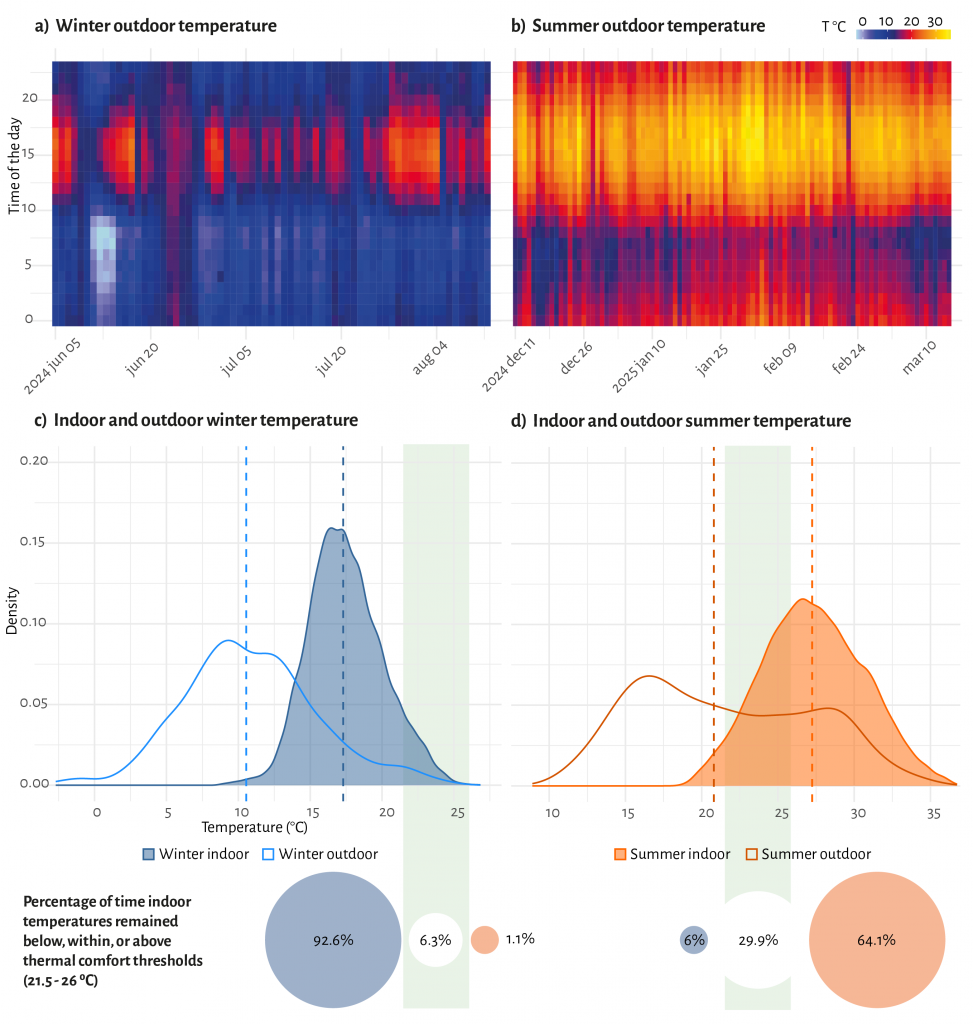
This study examines how personal comfort systems (PCS) support thermal adaptation among adults with intellectual disabilities living in energy-poor households in Chile. Participants (n = 8) in two identical social-housing units completed two in-home field campaigns: winter (June–August 2023; 10 weeks) and summer (December 2023–March 2024; 14 weeks). The study combined an adapted daily point-in-time thermal comfort questionnaire, continuous indoor dry-bulb temperature monitoring (15 min), and pre-/ post-season interviews. Indoor conditions frequently fell outside reference comfort thresholds (92.6% of winter temperatures < 21.5°C; 64.1% of summer temperatures > 26°C). Using participant-level paired comparisons with thermal preference ‘No change’ as a comfort proxy, PCS use showed no systematic winter increase (median Δ = −0.014; p = 0.944) but a consistent summer increase (median Δ = 0.126; p = 0.014). Interview accounts indicated that PCS supported everyday adaptation, while operability and access constraints sometimes limited independent use. Findings highlight the potential of inclusive PCS to improve perceived comfort under summer heat stress, alongside the need for complementary building-level measures to reduce thermal exposure in vulnerable housing.
Palabras clave
thermal comfort; personal comfort systems; energy poverty; intellectual disability; environmental control; Chile
DOI: https:// doi.org/10.5334/bc.695